



Limits Aren’t Needed Until They’re Needed
July 13, 2026
Principles taken from Child Parent Relationship Training by Sue Bratton and Garry Landreth
A young girl is in the car with her mother on the way to a birthday party of a friend. Suddenly, the mother remembers the previous birthday party her child attended. Images of thrown cake because she didn’t get the piece with the icing flower, and a broken vase knocked over when she was running cross her mind. As the parent turns into the driveway, she quickly turns to the child and says, “Remember what happened last time! Say ‘please.’ Say ‘thank you.’ No yelling. No throwing. Do not run in the house!” These reminders are intended to be helpful. But are they?
When you, as a parent, state expectations or limits preemptively, you communicate a lack of confidence to your child. You are essentially saying, “I’m not sure you will behave.” Also, it’s irritating to the child and viewed as nagging. Ultimately, it’s not helpful.
A child’s self-esteem is boosted when a parent verbalizes their confidence that the child will remember their manners. The conversation on the way to the birthday party would be richer for the child if the parent said, “I know that you know how to behave at a party. I’ll trust you to ask me if you have any questions.”
I’m not saying not to set limits! Limits are absolutely needed. Healthy limits teach the child a skill and preserve the relationship. When a child is given a limit and chooses to comply, they are empowered. Power struggles lessen and their self-esteem is boosted. The ACT limit-setting method is an easy to remember framework.
Using the ACT Method of Limit-Setting
- A – Acknowledge the child’s feelings or desire
- Acknowledge the upset first. Name the child’s feeling or desire.
- C – Communicate the limit
- Set a neutral limit. A limit should be universally true and consistent.
- T – Target the alternative
- Ideally give the child two choices that relate to the need.
EXAMPLE
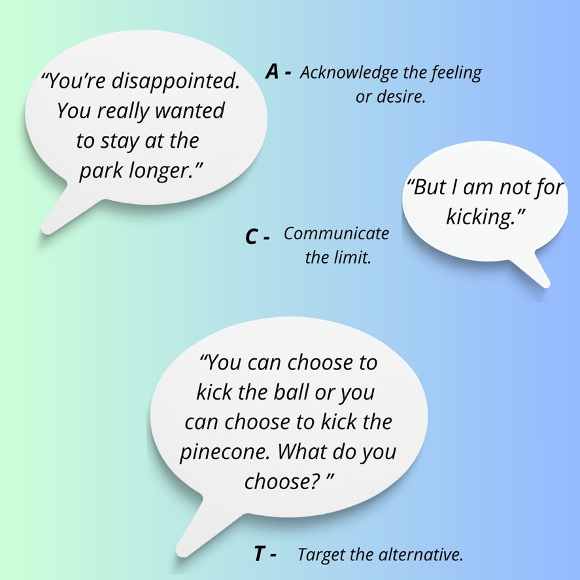
It can help to practice. Review a recent conflict and determine the A, C, and T you could use when the situation happens again. Say it aloud.
The Ultimate Limit
If the child does not make a choice, repeat the alternative three times. Before the third time, include the ultimate limit. Say, “If you choose not to choose, then I will choose for you.”
When there is still resistance, then a consequence can be given using choice language. For example, “If you choose to continue yelling, you are choosing no screen time.” Using the word choice is important for the child to develop greater personal responsibility. They chose.
Your relationship with your child is one of your top priorities. Setting limits by acknowledging their feelings in the moment (A), then communicating the limit clearly, concisely, and neutrally (C), and following with an opportunity to choose an acceptable expression of their feeling (T) preserves your relationship with your child.
You can drive to the next birthday party calmly. Your child may make questionable choices and that’s OK. They’re learning, and so are you.

